Choosing a sliding gate wheel
Four things decide which gate wheel you need: the groove profile, the diameter and width, the number of bearings, and how the wheel mounts to the gate.
Groove profile: V, O or U
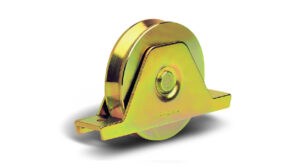
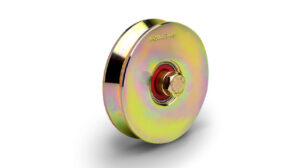
The groove around the wheel is shaped to sit on a matching track profile. V-groove wheels run on angled track, while O-groove and U-groove wheels suit rounded track profiles. Choose the groove to match your sliding gate track: a mismatched wheel wears quickly, runs noisily and can lift off the track. Some wheels in this range are made for a specific track size, such as the 1027 O-groove wheels for 16mm track.
Diameter, width and bearings
- Diameter. Our wheels come in 100mm and 120mm diameters. A larger wheel rolls more easily over small debris and spreads the load over more of the track.
- Width. 20mm wheels suit lighter gates, while 30mm wheels give a wider contact with the track for heavier gates.
- Bearings. Single-bearing wheels suit lighter domestic gates. Twin-bearing wheels share the load across two bearings for smoother running on heavier or frequently used gates.
As a general rule, the heavier the gate and the more often it opens, the more you should lean towards wider, twin-bearing wheels. Tell us the weight and length of your gate and we can recommend a wheel.
With or without a support
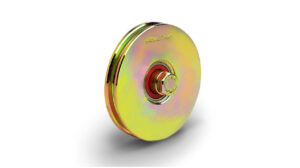
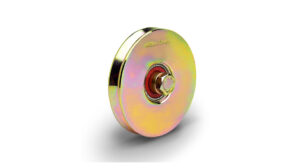
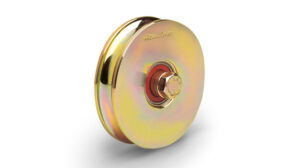
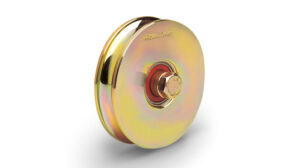
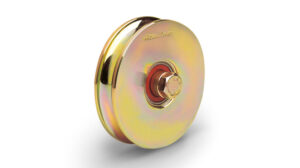
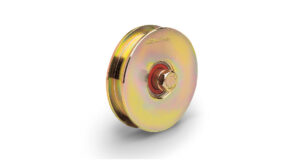
- Normal wheels have no bracket and are fixed into the gate’s bottom rail or a U channel by the fabricator.
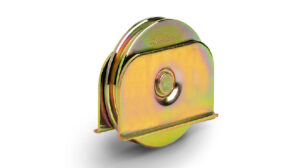
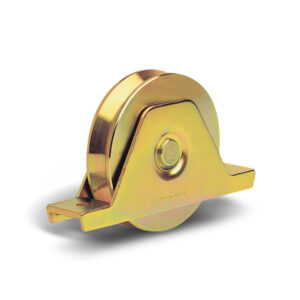
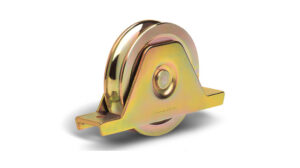
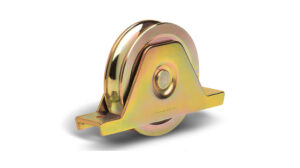
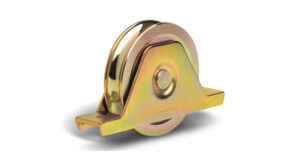
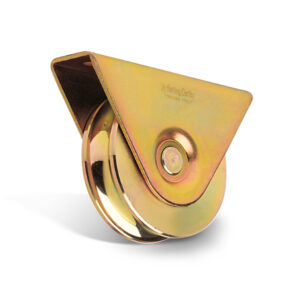
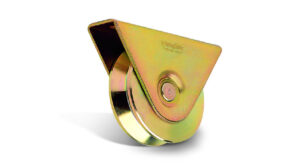
- Wheels with support come on a bracket that bolts or welds to the gate, which makes fitting and replacement easier.
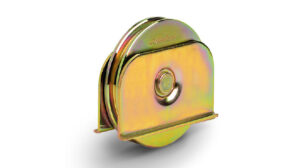
- Outer support and closed support wheels differ in bracket design, so check the product details to see which fixing suits your gate.
For a neat finish, many fabricators set the wheels into U channels along the bottom of the gate.
Our sliding gate wheel range
The range includes Rolling Center 1020 and 1030 series wheels (100x20mm and 100x30mm) in V, O and U groove, some in a yellow galvanised finish, the 1022, 1026 and 1027 supported wheels, the 1030 closed-support wheels, and the 1220 U-groove wheel with outer support at 120x20mm. Each product page lists its groove, size, bearings and support type.
Complete the sliding gate
Wheels work alongside the rest of your sliding gate hardware: the track they run on, guide rollers to keep the gate upright, travel stops, meeting points and gate keeps. For coastal or exposed sites, see stainless steel sliding gate hardware.
Building a very wide gate, or one that can’t run on a ground track? Cantilever gate hardware carries the gate on carriages and support wheels instead. For other gate types, see our full gate hardware range.
Frequently asked questions
Which sliding gate wheel do I need for my track?
Match the wheel’s groove to the track profile: V-groove wheels run on angled track, while O and U groove wheels suit rounded profiles. Check the track width too, as some wheels are made for a specific size such as 16mm. If in doubt, send us a photo and measurements of the track.
What size gate wheels do I need for a heavy gate?
For heavier gates, choose wider 30mm wheels with twin bearings. A 120mm diameter wheel also spreads the load and rolls more easily. Tell us the weight and length of your gate and we can recommend a size.
How many wheels does a sliding gate need?
Most tracked sliding gates run on two wheels, one near each end of the bottom rail. Longer or heavier gates sometimes need extra wheels to share the load. The wheels should be spaced so the gate stays balanced across its whole travel.
What is the difference between single and twin bearing gate wheels?
A single-bearing wheel runs on one bearing and suits lighter domestic gates. A twin-bearing wheel spreads the load across two bearings, so it runs more smoothly and lasts longer on heavy or busy gates. Twin bearings are the safer choice for automated gates that open many times a day.
Why is my sliding gate hard to push?
Stiffness usually points to worn wheel bearings, a wheel that doesn’t match the track, or debris and damage on the track. Check that the track is clean, straight and level, and that the wheels turn freely. Replacing worn wheels with the correct groove and size often restores smooth running.

 Pay in 3 interest-free payments.



 Shop Now, Pay with Klarna