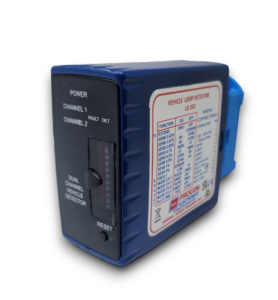
What is a loop detector?
A loop detector works with an induction loop: a length of cable laid in the ground under the driveway or road surface. The detector sends a signal through the loop and senses when a large metal object, such as a car or van, passes over it. It then sends a signal to the gate or barrier control panel, which can open the gate, keep it open, or stop it closing on a vehicle.
What are loop detectors used for?
- Free exit: automatically opens the gate or barrier as a vehicle approaches from inside the site, so drivers don’t need a fob or remote to leave.
- Safety: stops a gate or barrier closing while a vehicle is still in its path. On automated gates this works alongside photocells and safety edges.
- Presence and arming: confirms a vehicle is waiting at an entrance before an intercom, keypad or reader will operate, or holds a barrier open until the vehicle has cleared.
- Counting and car parks: detects vehicles entering and leaving, for car park systems and busy commercial sites.
Single or dual channel?
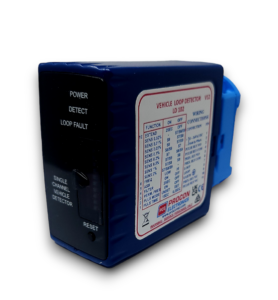
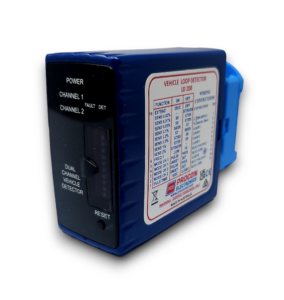
A single channel loop detector connects to one loop, which is ideal for a simple free exit or a single safety loop. A dual channel detector runs two loops from one unit, for example an exit loop and a safety loop on the same gate, or two loops on either side of a barrier. Using one dual channel unit saves space in the control panel and keeps the wiring simpler.
Boxed or card detectors?
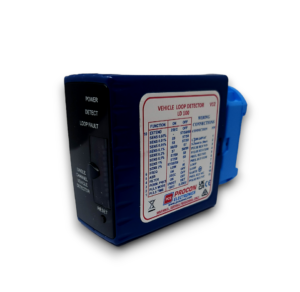
- Boxed detectors (Procon LD100, LD102, LD200, LD202) are self-contained units that mount separately inside the gate or barrier enclosure. The dual channel LD200 and LD202 come with a base.
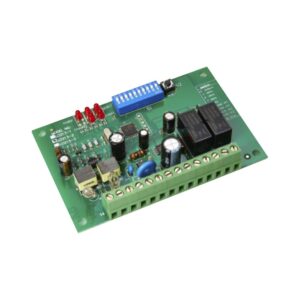
- Card detectors (Procon LD113-2, LD213) are compact board-style units designed to fit into a compatible control panel or enclosure.
24V or 230V?
Match the detector’s supply voltage to the power available in your control panel. Most modern gate and barrier panels provide a 24V supply, so the LD102, LD113-2, LD202 and LD213 suit most installations. The LD100 and LD200 are 230V models for sites where mains power is used in the enclosure.
Wired loops vs wireless and virtual loops
A traditional induction loop needs to be cut into the ground surface, which is best planned in at installation or when resurfacing. If cutting in a loop isn’t practical, there are alternatives:
- Wireless loops: the AES E-Loop sits on or in the ground and talks to a transceiver at the gate, with no cable to lay across the driveway. See our Wireless Vehicle Detection range.
- Virtual loops: the BEA Evoloop uses sensor technology to detect vehicles at automatic barriers without a buried loop.
- Magnetic probes: the Procon MD102 magnetic probe system uses a buried probe on a cable instead of a cut loop.
- Above ground sensors: the Optex OVS-02GT detects vehicles from above ground.
What else do you need?
- Induction loop cable to form the loop.
- A gate or barrier control panel with a detector input.
- Photocells and safety edges where the loop is part of the site’s safety system.
Why buy loop detectors from Rolling Center?
We supply wired and wireless vehicle detection alongside the gate automation, barriers and access control it connects to, so you can source a complete system from one supplier. Orders placed before 3pm go out on next day delivery, and our technical team can help you choose the right detector, loop layout and wiring for your installation.
FAQs
How does a loop detector work? An induction loop is laid in the ground and connected to the loop detector. When a vehicle passes over the loop, the metal in the vehicle changes the loop’s signal. The detector senses this change and sends a signal to the gate or barrier controller.
What is the difference between an exit loop and a safety loop? An exit loop opens the gate or barrier automatically when a vehicle approaches from inside the site. A safety loop stops the gate or barrier closing while a vehicle is still over it. A dual channel detector can run both from one unit.
Do I need a single or dual channel loop detector? Choose single channel if you only need one loop, such as a free exit. Choose dual channel if you need two loops, such as an exit loop and a safety loop, on the same gate or barrier.
Can I use a loop detector with any gate motor? Most gate and barrier control panels have an input for a loop detector, but check the detector’s voltage and output match your panel before you order. Our technical team can check compatibility for you.
What can I use if I can’t cut a loop into the driveway? A wireless loop such as the AES E-Loop, a magnetic probe detector, or a virtual loop such as the BEA Evoloop can all detect vehicles without cutting a loop into the surface.
Will a loop detector detect people or bikes? Loop detectors are designed to detect vehicles, so they generally won’t pick up pedestrians. Bicycles and motorbikes carry much less metal and may not be detected reliably, so they shouldn’t be relied on as a safety measure for pedestrians.

 Pay in 3 interest-free payments.



 Shop Now, Pay with Klarna